Is Your DIY Watch Waterproof? Pressure Testing Explained
Why a home-built dive watch needs a shop pressure test before swimming, which seals you control, and a seven-step checklist to prepare for the test.

DIY watch water resistance depends on how you closed the case, not only on the rating printed on it, so treat a home build as not waterproof until a watch shop has pressure-tested it. A passed test tells you the gaskets, crown and case back are sealing the way the case maker intended.
Building a dive watch you hope to swim with? Start with a case made for it, like the one in the Prodi Dive Kit.
Can you swim with a watch you built yourself?
Only after it passes a pressure test. Until then, keep it away from sinks, showers and pools.
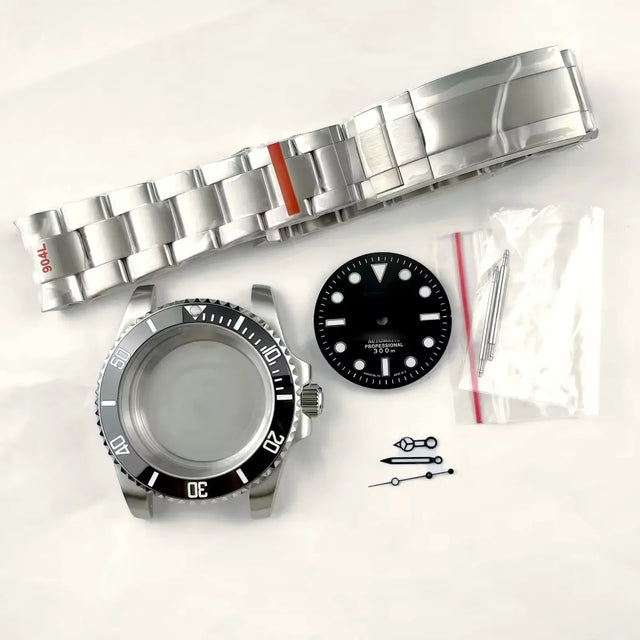
A dive case is designed to be water resistant, and ours is rated 300 m by its maker. That rating describes what the case can do when it is sealed correctly. When you build at home, the seal depends on you: a gasket that is pinched, dry, twisted or carrying a single hair can let water in at a fraction of the rated depth. You cannot see this by looking. The only way to know is to test it.
Water in a mechanical watch is not a small problem. It fogs the crystal, rusts steel parts and can stop the movement. A test before the first swim is far cheaper than a ruined movement.

Dive case included
Prodi Dive Kit 40mm Automatic
$299 Standard automatic · $399 Japanese NH35A
316L steel case rated 300 m by its maker · bezel and crystal fitted · spare stem
See the kitWhat is a watch pressure test?
A machine puts the watch under air or water pressure equal to a set depth and checks whether any air or water gets into the case.
Most watch shops use a dry tester. The watch sits in a sealed chamber, pressure is raised, and a sensor measures whether the case flexes in a way that shows a leak. Some shops follow with a wet test, where the watch is pressurized under water and any stream of bubbles shows where the leak is. For reference, the dive watch standard ISO 6425 tests at 125% of the rated pressure, because seals age and a swimming arm adds pressure beyond static depth. Your shop does not need to go that far for everyday swimming; ask what pressure they test to.
Which seals keep water out?
DIY watch water resistance relies on three seals: the case back gasket, the crown and tube gaskets, and the crystal gasket. In a kit, the crystal is already fitted, so you control the first two.
| Seal | Who fits it | What to check |
|---|---|---|
| Crystal gasket | Fitted in the kit | No chips at the crystal edge |
| Case back gasket | You | Seated flat, clean, lightly greased |
| Crown gaskets | You, when fitting the crown | Crown fully home, gasket intact |
| Bezel | Fitted in the kit | Not a water seal; just turns |
The case back gasket is the most common failure in a home build. It must sit flat in its groove, with no twist and no dust. A thin film of silicone grease helps it seal and stops it tearing as the back screws down. Our guide to opening and closing a screw-down case back covers this.
Why does the crown matter so much?
The crown is the part you move most. If your case has a screw-down crown, one left unscrewed after winding is an open door.
The crown also seals only if the stem is cut to the right length. Too long, and the crown cannot seat against the tube. Too short, and it may not engage fully. After any winding or time setting, push the crown in, and if it screws down, turn it until snug. Do not force it.
How do you prepare a DIY watch for a pressure test?
Close it carefully, check every seal, then take it to a watch shop and ask for a pressure test before it touches water.
- Inspect the case back gasket for nicks or stretching and replace it if in doubt.
- Clean the gasket and groove with a blower; no lint, no hair.
- Apply a thin film of silicone grease to the gasket.
- Seat the gasket flat and screw the case back down evenly until snug.
- Check the crown sits fully home against the tube.
- Take the watch to a watch shop and ask for a pressure test.
- If it fails, ask where it leaked; a new case back gasket often solves it.
How much does a pressure test cost?
It varies by shop and by whether they do a dry or wet test, so call a few local watch shops or jewelers and ask.
A pressure test takes minutes, and many jewelers with a service counter offer it. Ask whether they test dry, wet or both, and to what pressure. Seals age, so many makers recommend testing again every one to three years, and after any time the case is opened.
Opened the watch again later to change the hands or fit a new dial? Test it again. For your water days, a 20 mm rubber strap is easier to rinse than a bracelet. If you are still at the start, our guide on how to build a watch covers the full build.
The bottom line
DIY watch water resistance is earned at the bench and proven at a watch shop: seal the case back and crown with care, then get a pressure test before you swim. Start with a case made for water, such as the one in the Prodi Dive Kit.
Frequently asked questions
Is a 300 m rated watch safe for diving?
Only once it is sealed correctly and tested. A home build should be pressure-tested by a watch shop before it goes in water.
Can I pressure test a watch at home?
Not reliably. A bowl of water shows only large leaks and can flood the watch. A shop tester is safer.
Do I need to retest after changing the strap?
No. Straps attach outside the case. Retest only when the case back or crown has been opened or replaced.
Can I shower with my DIY watch?
Wait for a passed test. Even then, hot water and soap age gaskets, so many owners take it off.
What does a failed test usually mean?
Most often a case back gasket that was pinched, dry or dirty, or a crown that was not fully home.
Sources
- Wikipedia, Water Resistant mark: en.wikipedia.org/wiki/Water_Resistant_mark
Keep reading