How to Wind and Set an Automatic Watch
Crown positions, how many turns an NH35 needs, why you cannot overwind it, and a safe seven-step order for setting the date and time.

Here is how to wind an automatic watch: with the crown pushed fully in, turn it clockwise 30 to 40 times to get it running, or about 55 turns for a full wind on an NH35. After that, wearing it every day keeps it going, and you only set the date and time when it stops.
If your watch spends nights or weekends off the wrist, a single watch winder keeps it running so you never reset it.
How do you hand wind an automatic watch?
Leave the crown in its normal pushed-in position and turn it clockwise with smooth, steady strokes. Turning the other way does nothing.
Most automatic movements, including the NH35 and NH35A, wind from the crown in the first position, which is the one it sits in when you wear it. If your watch has a screw-down crown, as many dive watches do, first unscrew it counterclockwise until it pops out to that free position. Then hold the watch in one hand and turn the crown between thumb and finger. On the NH35 you will feel a light, smooth resistance with a quiet ratchet sound. Counterclockwise simply slips. When you finish, push the crown back in and screw it down again firmly before the watch gets wet.
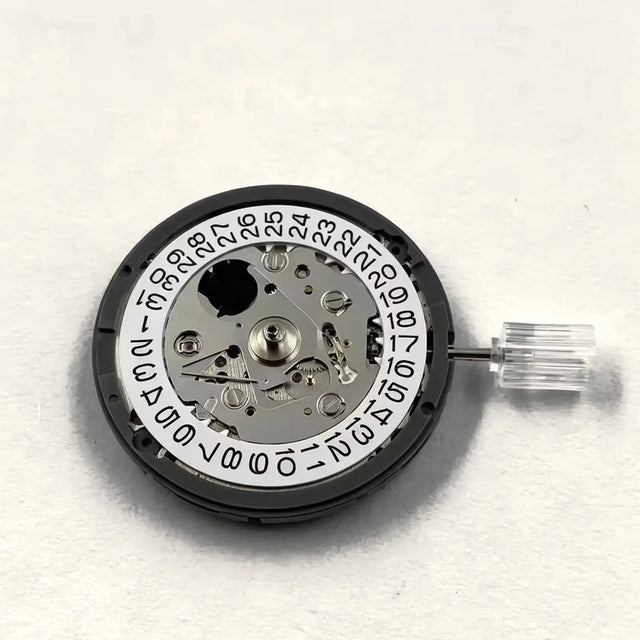
For a closer look at the movement inside your kit, see our NH35A movement guide.

Keep it running
Single Watch Winder
$169
Holds one watch · four finishes · keeps an automatic wound off the wrist
See the winderHow many turns does an automatic watch need?
For an NH35, about 30 to 40 turns gets a stopped watch running well, and about 55 turns reaches a full wind of roughly 41 hours.
The exact number depends on the movement, so check your model's spec. A few turns will start the balance, but a watch started with only a handful of turns may stop again within hours if you do not wear it much. A good habit is a full wind in the morning whenever the watch has been sitting, then let the rotor take over.
Does wearing it wind the watch on its own?
Yes. The rotor inside spins as your wrist moves and winds the mainspring, so daily wear usually keeps it running without any hand winding.
How much it winds depends on how active you are. A day of walking and moving keeps it topped up. A day at a keyboard may add less than the watch uses, especially if you started with a low reserve. That is why a watch can stop overnight even though you wore it all day. If you see that pattern, give it 20 or so turns in the morning.
Can you overwind an automatic watch?
No. Automatic movements have a slipping clutch on the mainspring, so once it is full the crown keeps turning without adding tension.
This is different from many older hand-wound watches, where you feel a hard stop. On an automatic you will not feel a stop at all, which is normal. There is no benefit to winding past the 55 or so turns a full wind takes, so do not spend minutes spinning it.
How do you set the date and time correctly?
Set the date at the first crown click and the time at the second, and never change the date between about 9 p.m. and 3 a.m.
| Crown position | What it does on an NH35 | Tip |
|---|---|---|
| Pushed in | Hand winding (clockwise) | Screw down after winding |
| First click | Quickset date | Avoid 9 p.m. to 3 a.m. |
| Second click | Set time, seconds hand stops | Sync to a reference clock |
The date mechanism engages during those late hours as it prepares to change, and forcing it with the quickset can damage the date wheel. Follow this order and you avoid the problem entirely:
- Wind the watch about 30 turns so it runs strongly.
- Pull the crown to the second click and move the hands to 6:00.
- Push to the first click and set the date to yesterday's date.
- Pull to the second click and turn the hands forward until the date changes. You are now at midnight.
- Keep going to the correct time, adding 12 hours if it is afternoon.
- Stop the seconds hand at 12, wait for a reference clock to reach the minute, and push the crown in.
- Screw the crown down if your case has a screw-down crown.
Time.gov from the National Institute of Standards and Technology is a good reference clock for step 6.
What if the watch still stops?
If you followed how to wind an automatic watch and it still stops, check that the crown is fully in and the hands are not touching.
A watch that will not run after a full wind usually has a crown or hand clearance issue. Our NH35 not running checklist walks through it. And if a bracelet that slides around is making it hard to wear daily, our guide to sizing a watch bracelet helps.
The bottom line
Once you know how to wind an automatic watch, it takes less than a minute: crown in, 30 to 55 clockwise turns, then wear it. Set the date outside 9 p.m. to 3 a.m. and use the second click for the time. If you switch between watches, a single watch winder saves the resetting.
Frequently asked questions
How long will an automatic watch run off the wrist?
An NH35 runs about 41 hours from a full wind, then stops until you wind or wear it again.
Is it bad to let an automatic watch stop?
No. It does no harm. You just need to wind it and reset the date and time.
Should I wind my watch every day?
Only if you do not wear it much. Regular wear keeps it wound.
Which way do I turn the crown to wind?
Clockwise, with the crown pushed in. The other direction slips freely.
Can I shake the watch to wind it?
A few swings start it, but it stores little power that way. Hand winding is quicker.
Sources
- Caliber Corner, NH35A specifications: calibercorner.com/seiko-caliber-nh35a
- Wikipedia, Automatic watch: en.wikipedia.org/wiki/Automatic_watch
- NIST official U.S. time: time.gov
Keep reading