NH35 Accuracy: What -20 to +40 Seconds a Day Means
What Seiko's published rate range means in minutes per week, why a mechanical movement drifts, and a simple six-step way to measure your own watch.

NH35 accuracy is rated by Seiko at -20 to +40 seconds per day for the Seiko TMI NH35A, so a new movement may lose up to 20 or gain up to 40 seconds a day and still be in spec. In daily wear, that usually means resetting it about once a week.
Want the movement that carries Seiko's published spec? See the Japanese NH35A movement.
What does -20 to +40 seconds a day actually mean?
It is the range a new NH35A is allowed to run at under normal conditions. Anything between losing 20 and gaining 40 seconds a day is within spec.
The spec is wide on purpose. The NH35A is a mass-produced, unadjusted movement, and Seiko states a range it can promise for every unit rather than a best-case number. According to Caliber Corner, the figure is measured without the date mechanism active. Here is what the extremes of the range add up to over time:
| Daily rate | Per week | Per 30 days |
|---|---|---|
| -20 s/day | 2 min 20 s slow | 10 min slow |
| +10 s/day | 1 min 10 s fast | 5 min fast |
| +40 s/day | 4 min 40 s fast | 20 min fast |
In practice nobody wears an automatic watch for 30 days without touching the crown. The watch stops when you leave it, you reset it, and the error starts over.

Published spec
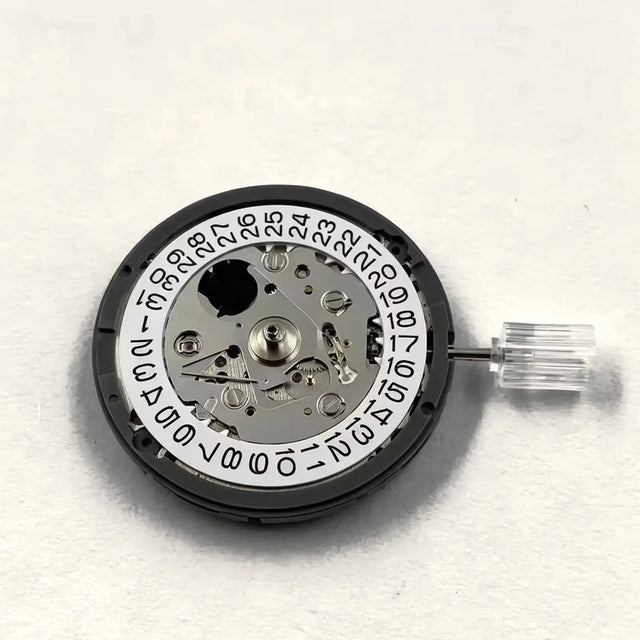
Japanese Automatic Movement NH35A
$269
Seiko TMI NH35A · 24 jewels · 21,600 bph · about 41 h reserve · hacking
See the movementWhy does an NH35 gain or lose time?
Because a mechanical balance wheel reacts to position, power level, temperature and magnetism, and each one nudges the rate a little.
The NH35 keeps time with a balance wheel swinging at 21,600 beats per hour (3 Hz). Anything that changes how far or how evenly it swings changes the rate:
- Position. Dial up, crown down and crown up each run slightly differently because gravity acts on the balance differently.
- Power level. A nearly empty mainspring delivers less energy, and the rate often drifts in the last hours of the reserve.
- Temperature. Warmth from your wrist versus a cold nightstand changes the hairspring slightly.
- Magnetism. A magnetized hairspring can make a watch gain minutes a day. This is the most common cause of a sudden, large change.
- Shock. A hard knock can shift the rate until the watch is regulated again.
How do you measure your NH35's accuracy?
Compare it with an official clock over 24 hours, at the same time each day, with the watch fully wound.
- Wind the watch fully, about 55 turns of the crown.
- Open time.gov, the official U.S. time from NIST, on your phone or computer.
- Pull the crown to the second click to stop the seconds hand, set the hands exactly, and push in on the minute.
- Wear the watch normally for 24 hours.
- At the same time the next day, note how many seconds ahead or behind it reads.
- Repeat for three to five days and average the results.
A few habits make the reading more useful. Check one day after a full wind rather than at the end of the reserve. Write down how the watch spent the night, because dial up and crown down give different results. If the number jumps suddenly by minutes, suspect magnetism before anything else. A timing app or a timegrapher gives an instant reading, but the 24-hour check is the one that reflects real wear.
Can NH35 accuracy be improved?
Yes. A small regulator lever on the balance can be moved to speed up or slow down the rate, but it needs care and the right setup.
Moving the regulator changes the effective length of the hairspring. It is a delicate job, and a slip can damage the hairspring. Before anyone adjusts it, the watch should be demagnetized and measured over several days. If your watch runs within spec, the simplest option is to reset it weekly. If it is far outside spec, we would rather you send us a photo and your readings first.
Another easy trick is overnight positioning. Each position runs a little differently, so leaving the watch crown up or dial up overnight can nudge the rate one way or the other. Test what your watch does before relying on it.
Is the NH35A more accurate than a standard NH35?
The NH35A is the version Seiko publishes the -20 to +40 spec for. Our Standard automatic is NH35-compatible but does not carry that published spec.
Both fit the same cases, dials and hands, so the choice mostly comes down to whether you want the published rating. Our NH35 vs NH35A comparison explains the differences in detail. If you are troubleshooting rather than measuring, the NH35 not running checklist helps, and our guide to winding and setting an automatic watch covers the crown.
The bottom line
NH35 accuracy of -20 to +40 seconds a day is honest everyday performance for a mechanical watch, and measuring your own over a few days tells you more than any spec sheet. If you want the movement Seiko publishes that rating for, choose the Japanese NH35A.
Frequently asked questions
Is the NH35 accurate enough for daily wear?
Yes. Within spec, it drifts less than five minutes a week, and you can reset it in seconds.
Why is a quartz watch more accurate?
A quartz crystal vibrates at 32,768 times per second and is far less affected by position and power level, so it drifts much less.
Does the NH35 run faster when new?
Rates can shift a little over the first weeks of wear. Measure again after a week or two before judging.
Can magnetism make my NH35 run fast?
Yes. A magnetized movement often gains minutes per day. A watch shop can demagnetize it quickly.
How do I check accuracy without tools?
Set it to time.gov, wear it for 24 hours, and compare at the same time the next day.
Sources
- Caliber Corner, NH35A specifications: calibercorner.com/seiko-caliber-nh35a
- NIST official U.S. time: time.gov
- Wikipedia, Quartz clock: en.wikipedia.org/wiki/Quartz_clock
Keep reading