What Do Watch Jewels Do? 24 Jewels Explained
Why mechanical movements use synthetic ruby bearings, what a 17 or 24 jewel count tells you, and why a higher number does not automatically mean a better watch.

The watch jewels meaning is simpler than it sounds: jewels are tiny synthetic rubies set into a mechanical movement as bearings, so the steel pivots of the gears turn with low, steady friction. They are functional parts, not decoration, and a count like 24 jewels tells you how many of those bearings the movement uses.
Want to see them up close? Our Standard automatic movement is a good place to start for a first build.
What are jewels in a watch?
They are small bearings, usually synthetic ruby or sapphire, with a precise hole that a gear's pivot turns in. Their job is to cut friction and wear.
A mechanical watch runs on a tiny amount of energy from a coiled mainspring. That energy passes through a chain of gears to the escapement and balance wheel. Every pivot along the way creates friction. If a steel pivot turned directly in a brass plate, the hole would wear oval over time and the watch would lose amplitude and accuracy. A hard, polished jewel gives the pivot a smooth, durable seat that holds a drop of oil in place.
Synthetic ruby and sapphire are both forms of crystalline aluminum oxide. Early watches used natural stones, but a method for making synthetic ruby developed in the early 1900s made jewel bearings cheap enough for everyday watches. So, to clear up the watch jewels meaning for anyone wondering about value: they are not precious gems in any resale sense.

Movement
Standard Automatic Movement (NH35-compatible)
$119
NH35 layout · Hacking · Hand-winding · Date at 3
See the movementWhy does the NH35A have 24 jewels?
A basic time-only watch is considered fully jeweled at 17. The Seiko TMI NH35A adds automatic winding, a date and hacking, and its extra jewels support those added parts.
The classic 17 cover the main load points: the balance wheel, the pallet fork, the escape wheel, the fourth, third and center wheel pivots, plus two cap jewels on the balance. An automatic movement adds a rotor and a winding system that turns all day as you move, so jewels in that train help keep it smooth and long-lasting. The exact placement varies by movement design, but the principle holds: jewels go where parts move under load. For how the rotor and mainspring work together, read how an automatic watch works.
| Jewel count | Typical movement | What it tells you |
|---|---|---|
| 0 to a few | Most quartz watches | Little torque, so bearings matter less |
| 17 | Time-only mechanical | Fully jeweled main train and balance |
| 21 to 26 | Many automatics with date | Extra jewels for winding and complications |
| Very high counts | Complicated or marketing-led | Check where the jewels actually are |
Are more jewels better in a watch?
Not by themselves. Past the count a design needs, extra jewels add little. A well-made 21 or 24 jewel automatic is not worse than a 30 jewel one.
Jewel counts were once printed proudly on dials as a selling point, which is how the number came to feel like a measure of quality. Today the useful question is whether the movement is well designed, well assembled and serviceable. Accuracy depends far more on regulation, the balance and the hairspring than on the jewel count. Quartz watches show the other side of this: many have few or no jewels because their motors need so little torque.
How do you count and check jewels yourself?
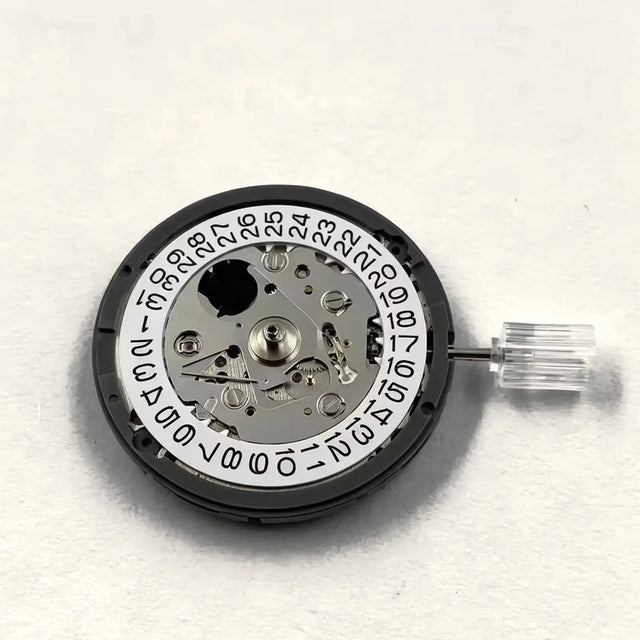
Look through a display case back or at a bare movement with a loupe. The jewels are the small red or pink dots set into the plates and bridges.
- Lay the movement or watch face down on a soft cloth under good light.
- Use a loupe or a phone camera on macro to look at the bridges.
- Find the balance wheel; you will see a jewel at its center with a cap above it.
- Follow the gear train from the balance toward the center and note each red dot.
- Remember that some jewels sit under the dial side and cannot be seen from the back.
- Compare what you see with the count printed on the rotor or in the spec sheet.
Never press on a jewel or try to clean it with a tool. They are small and set to a precise depth. If you are curious about taking movements further, our guide to the watchmaking hobby covers how people progress from assembly to servicing.
Do jewels change the price of a watch?
Only slightly, and indirectly. Synthetic jewels are inexpensive. Price differences between movements come mostly from finishing, testing and brand.
Our two movements show this well. The Standard automatic is NH35-compatible and costs $119. The Japanese NH35A, a Seiko TMI NH35A, costs $269 and comes with Seiko's published spec of 24 jewels, 21,600 bph and about 41 hours of power reserve. Both are built around the same layout. The gap is about the specific movement you get, not about extra rubies. Our comparison of NH35 vs NH35A goes deeper, and mechanical vs automatic vs quartz explains why quartz rarely needs jewels at all.
The bottom line
That is the watch jewels meaning in short: synthetic ruby bearings that reduce friction where gears turn. Seventeen covers a basic watch, 24 in the NH35A covers automatic winding and the date, and more is not automatically better. To see a 24 jewel movement working in a watch you built yourself, look at our Japanese NH35A movement or the full Prodi Dive Kit.
Frequently asked questions
Are watch jewels real rubies?
They are synthetic ruby, which is chemically the same material as natural ruby but made in a lab. They have almost no resale value.
What does 17 jewels mean on a watch?
It usually means a time-only mechanical watch is fully jeweled at its main pivots, balance and escapement.
Do quartz watches have jewels?
Many have none or only a few, because the quartz motor produces very little torque and the bearings carry little load.
Can jewels wear out?
Jewels are very hard and rarely wear. The oil on them dries out over the years, which is why mechanical watches benefit from servicing.
Sources
- Jewel bearing: en.wikipedia.org/wiki/Jewel_bearing
- Seiko caliber NH35A specs: calibercorner.com/seiko-caliber-nh35a
Keep reading