How Does an Automatic Watch Work?
A clear walk through the rotor, mainspring, escapement and balance wheel, how long an automatic runs off the wrist, and how it differs from quartz.

How does an automatic watch work? A weighted rotor spins as your wrist moves and winds a spiral mainspring, and that spring releases its energy in tiny, even steps through a balance wheel that swings back and forth several times a second. No battery is involved; your movement is the fuel.
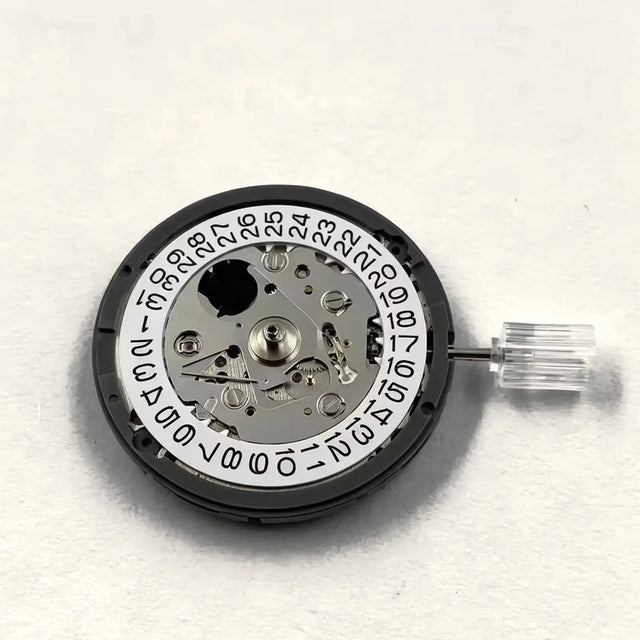
Want to hold one in your hand and see the rotor turn? Our Standard automatic movement is NH35-compatible and fits our cases.
What does the rotor do in an automatic watch?
The rotor is a half-moon weight on the back of the movement that pivots as you move and winds the mainspring through a set of small gears.
Turn an automatic watch over, and if it has a display back you will see the rotor. Every time your wrist moves, gravity pulls the weight around its center. Reverser and reduction gears turn that swinging into slow, steady winding of the mainspring. Some designs wind in one direction only; the NH35 family winds in both, which makes better use of small movements. This is the "automatic" part. Everything else in the watch is the same as a hand-wound mechanical watch.

See it for yourself
Standard Automatic Movement (NH35-compatible)
$119
Automatic and hand-winding · date at 3 · fits NH35 cases, dials and hands
See the movementWhat is the mainspring?
It is a long, coiled spring inside a small drum called the barrel. Winding tightens it, and as it unwinds it drives the gears.
The mainspring is the watch's battery. The rotor or the crown tightens it, storing energy. To stop it from being overwound, an automatic mainspring has a slipping clutch: once the spring is full, the end slips inside the barrel instead of tightening further. That is why you never feel a hard stop when winding an automatic by hand.
How does the balance wheel keep time?
The balance wheel swings back and forth on a fine hairspring at a steady rate, and the escapement lets the gears move forward one small step per swing.
Without the balance, the mainspring would unwind in seconds. The escapement acts as a gate: it locks the gear train, then releases it one tooth at a time as the balance swings past. Each release also gives the balance a small push to keep it going. That stop-and-go is the tick you hear. The NH35A beats 21,600 times per hour, or 3 Hz, which is why its seconds hand sweeps in small steps rather than jumping once per second.
If someone asks you how does an automatic watch work, this is the whole answer in six steps, from your wrist to the hands:
- Your wrist moves and the rotor swings.
- Reverser and reduction gears turn that motion into winding.
- The mainspring tightens and stores energy in the barrel.
- The barrel turns the gear train as the spring unwinds.
- The escapement releases the train one step per balance swing.
- The balance and hairspring set the rhythm, and the hands move.
| Part | Job | Think of it as |
|---|---|---|
| Rotor | Winds the mainspring from wrist motion | The charger |
| Mainspring | Stores energy | The battery |
| Gear train | Carries energy to the hands | The drivetrain |
| Escapement | Releases energy in steps | The gate |
| Balance wheel | Sets the beat | The metronome |
For a wider tour that includes the case, dial and crown, see our guide to the parts of a watch.
How long does an automatic watch run when you take it off?
Until the mainspring runs down. For the Seiko TMI NH35A, a full wind gives about 41 hours.
If you take it off on Friday night, it will probably have stopped by Sunday. That is normal and harmless. Wind it about 30 to 40 turns at the crown, set the time, and it is back. Our guide on how to wind and set an automatic watch covers this, and do you need a watch winder covers keeping it running off the wrist.
How is an automatic different from quartz?
An automatic runs on a spring and a swinging balance; a quartz watch runs on a battery and a vibrating quartz crystal.
A quartz crystal vibrates 32,768 times per second, and a circuit counts those vibrations to drive a small motor. That makes quartz more accurate and lower maintenance. An automatic is less accurate, with the NH35A rated -20 to +40 seconds per day, but it needs no battery and you can watch it work. Mechanical watches also need occasional cleaning and oiling by a watchmaker.
Curious about the two versions of the movement in our kits? Read NH35 vs NH35A.
The bottom line
So, how does an automatic watch work? Your movement winds a spring, and a balance wheel lets that energy out in steady steps that move the hands. The best way to understand it is to hold one, and our Standard automatic movement is an affordable place to start.
Frequently asked questions
Does an automatic watch need a battery?
No. It is powered entirely by the mainspring, wound by the rotor or the crown.
Can you overwind an automatic watch?
No. A slipping clutch lets the mainspring slip once it is full.
Why does the seconds hand sweep?
Because the balance beats several times per second, the hand moves in small steps that look like a sweep.
Is an automatic the same as a mechanical watch?
An automatic is a mechanical watch with a rotor that winds it for you. A manual mechanical watch must be wound by hand.
Does an automatic watch need servicing?
Yes, now and then. Mechanical watches need periodic cleaning and oiling by a watchmaker.
Sources
- Wikipedia, Automatic watch: en.wikipedia.org/wiki/Automatic_watch
- Wikipedia, Mechanical watch: en.wikipedia.org/wiki/Mechanical_watch
- Wikipedia, Quartz clock: en.wikipedia.org/wiki/Quartz_clock
Keep reading